
What is RAG and how do you turn it into a working company knowledge base?
With Retrieval-Augmented Generation, AI answers based on your own documents, with citations. We explain how it works, the pitfalls and the steps to implement it.
Large language models (LLMs) write impressively, but they have two serious limitations: they do not know your company's internal documents, and when they do not know the answer they tend to confidently make one up. Retrieval-Augmented Generation (RAG) addresses both problems.
How does RAG work?
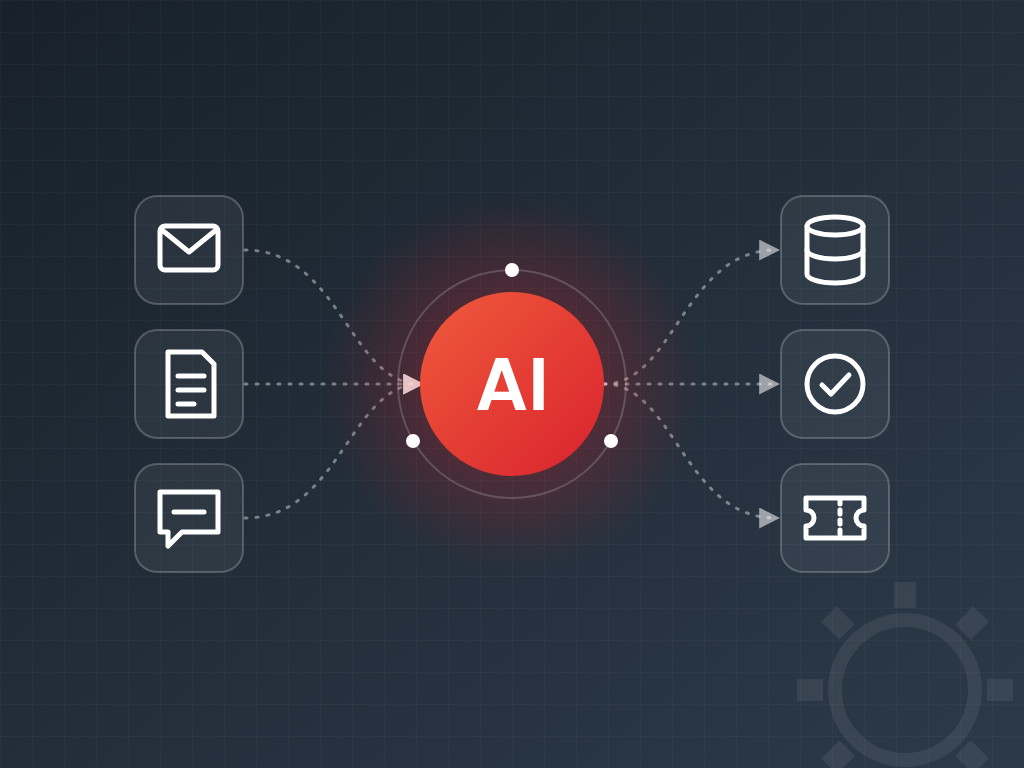
The idea behind RAG is that the model does not answer from its own "memory". It first retrieves the passages related to the question from your documents and receives them as context. The process has two main stages:
- Indexing: documents (PDF, Word, wiki pages, emails) are split into smaller chunks of a few paragraphs, and an embedding model assigns each chunk a numeric vector describing its meaning. The vectors are stored in a vector database.
- Querying: the user's question is also turned into a vector, the passages closest in meaning are retrieved, and they are passed to the LLM together with the question and an instruction to answer only on that basis and cite the source.
RAG does not retrain the model: knowledge stays in the documents, so as soon as a new policy is uploaded the system "knows" the new information.
Why is this better than a simple chatbot?
- Verifiability: every answer comes with the cited document and paragraph.
- Freshness: no expensive, slow fine-tuning – updating the documents is enough.
- Access control: retrieval can respect who is allowed to see which documents.
- Data protection: the whole system can run on your own servers with a local language model.
The most common pitfalls
A working demo can be put together in an afternoon, but a reliable enterprise system needs more. In our experience, quality depends most on these factors:
- Chunking: chunks that are too small lose context; chunks that are too large make retrieval imprecise. Chunking that follows the document structure (sections, tables) helps a lot.
- Hybrid search: combine semantic (vector) search with keyword search – it finds part numbers, abbreviations and proper names much more reliably.
- Reranking: a second model selects the truly most relevant passages from the candidates.
- Poor source material: scanned, non-searchable PDFs and outdated versions – RAG is only as good as your document repository.
- Evaluation: measure answer accuracy regularly with a set of test questions, otherwise the effect of changes remains invisible.
How to roll it out
Recommended steps for an enterprise RAG project:
- Pick a well-defined domain (for example HR policies or technical documentation).
- Collect 30–50 real questions with their answers – this becomes your evaluation set.
- Build a prototype in 2–4 weeks and measure accuracy.
- Extend the document scope, add permissions and single sign-on.
- Integrate it into familiar tools: Teams, Slack, the intranet – or any AI assistant via an MCP server.
Summary
RAG is one of the fastest-paying enterprise AI solutions today: employees spend less time searching and company knowledge becomes accessible to everyone. The key to success is not choosing the model but good data preparation, tuned retrieval and continuous evaluation.